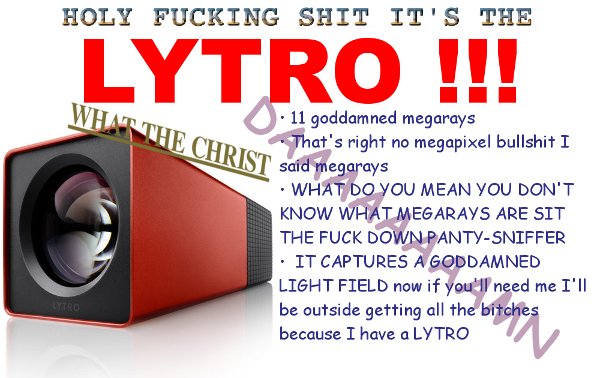
Actual advert for the Lytro.
from Shutter, by Lewis Collard
"I just went to your website, which led to me blocking you. Good bye! Hope you grow up one day." -- Eric Cheng, Director of Photography for Lytro, who doesn't like hard questions.
"Keep up the informationless, opinionated drivel, it keeps you off the street corner soapboxes." -- Simon Allen
Actual advert for the Lytro.
This article was written in 2012. I might have been right, but often for the wrong reasons. I don't like this article, but it's here almost untouched since for historical reasons.
That was almost all I had to say about the Lytro. It's a stupid gimmick, so all it actually needs in response is a stupid title and a stupid picture. Of course the nerd sites are gushing over it, but they'll do that over anything that sucks if it's marketed as something ground-breaking.
But hey, let's punch Lytro in the face some more: The Lytro is a bad idea. It's interesting technology, but interesting technology doesn't make a camera with which you'd actually want to take photographs. The resolution is abysmal, the onboard memory is not replaceable, it looks stupid, it solves a problem that hasn't been a problem since 1986, the files are fucking huge, every shot requires processing with their (and only their) proprietary software as it cannot shoot JPEGs straight from the camera (forcing you to sit in front of a computer is part of why HDR sucks), and even the nerd sites that otherwise gush over it describe the results as a "little bit soft". And here's what you get in return:
Whoop-dee. Thanks, but I'd rather shoot a real camera. Shit, I'd rather get a £100 Canon point-and-shoot digital camera for better results and spend the rest on train trips to some places I haven't been.
Skip to: Ergonomics | 8GB vs 16GB: Ren Ng hates you and thinks you are a moron. | Focus-free: Who cares? | Oh my Godding God it's HD! | The lens makes me nervous | But you haven't tried one yet! | Real-world picture quality | Everything else sucks about it too | Better ideas | But seriously | Elsewhere
I can only say: What the shit? It's a CCTV lens with a shutter button! One tech site I read (the link to which I mercifully lost) praised it for starting afresh and throwing away all the historical baggage from 35mm SLRs, which have been mostly evolution, and few revolutions, since the Contax S in 1949. See, one thing that happens all throughout history is that stuff evolves to be a certain way, and said stuff is very imperfect, then some folks come out like the Soviet Communists and say "this is all historical baggage, we can design everything from the ground up" and, in a very short time, everyone realises the hard way that all the cruft that has built up actually serves a good purpose.
35mm and digital SLRs need some work but they are as they are for a reason. Now, if the Lytro needs to be this stupid shape, and I suspect it does, then come right out and say that; it isn't innovation, it's necessity.
Hey, if all you take away from this is that
☭ ☭ ☭ Lytro = Communism ☭ ☭ ☭
then that's OK, too.
I'm not overstating the case here. The 8GB version of the Lytro is $399. The 16GB version is $499. That means you pay $100 for 8GB of extra solid state storage. That is a rip-off, and proof that Ren Ng actually hates you and thinks you are a moron for not noticing. (Hey guys, $499 is only a tiny bit short of a Pentax K-r, a real digital SLR which will work with every Pentax lens since 1975, will shoot HD video, and doesn't come from a company that treats you like a moron.)
Of course, selling you an 8GB solid-state storage device for $100 wouldn't work if you could buy the cheap one and pop a 16GB CF card in it, so of course they made the storage non-removable. Everyone knows how fickle solid state devices are, so yup, when your storage device dies you're going to have to send it off to Lytro to be repaired. which assumes that they will still exist as a company when that happens. (Don't count on it; I'm guessing that in two years Lytro will be gone, and there will be about 10 people who still care about the Lytro. Nine of them will be all the people who bought it and the tenth will be me dancing around singing "I told you so, fuckers!")
Extending this lesson to the iPhone is an exercise for the reader by which I mean Apple hates you too. At least they give you a free telephone with your camera.
I'm updating this in May 2012: the two versions used to be 16gb and 32gb, which is when I first said that Ren Ng hates you and thinks you're a moron. The difference between the two models was 16gb then, and 8gb now. I was right back then, and I'm even more right now that they're doing even more stupid Apple-ish product differentiation tricks.
Really, focusing isn't that hard; cameras have done that all by themselves since the mid-1980s. Most compact cameras and all camera phones are effectively focus-free anyway, if you're not doing macro or near-macro photography, because of the enormous depth of field given by their very short focal lengths (itself a consequence of their itty-bitty sensors).
Take $399, then divide that by the number of times you've missed a shot because you were waiting for your camera to focus. Is it worth it? I'd say no, but I'm also not you (but seriously it's not).
Save yourself $399 and read your camera's manual so you can get your photos in focus right from the camera. (Or get a Canon A-1; it's manual focus, which means your camera never focuses on the wrong thing.)
"HD" is a code word for "less resolution than digital cameras had in 1999".
OK, so one can live with 1080x1080 (1 megapixel) files for drunk snapshots; at least they'll take up less disk space. Wait, never mind, each file from the Lytro is twenty three megabytes. Sweet Jesus! That's nearly as big as a 12-bit NEF from a 24-megapixel Nikon D3X! I can't imagine how painful it is to work on files this size when you take into account all the refocusing tricks that the software has to do.
In their defense, Ren Ng has this to say:
It's very easy to get caught up in the specs of a device, but cameras are devices for taking pictures and sharing stories. We want to make the picture that is most meaningful. If people are sharing their images on Facebook, they're not using all those megapixels."
OK, gotcha. I've said pretty much the same thing elsewhere, and I even slept well that night because I wasn't simultaneously complaining about meaningless specifications and pushing "Light Field Engine 1.0 processor" as an actual feature. Over to Ren with the weather:
What are the qualitative elements of the device? The experience of taking the picture, the ease of use, the viewing experience. That's why we describe our camera with a different unit of capture - not megapixels but megarays.
That's right. Taking a picture with a Lytro can only be described in megarays: now that's an awesome and meaningful unit of measurement that everyone understands. Woohoo, the Lytro has fucking millions of these units that Lytro randomly made up! Sign me up; I bet it's even better than my APS camera and HD-DVDs.
Okay, the camera has a 35-280mm f/2 zoom. That's kind of cool. Except, it kind of isn't. 28-300-equivalent zooms (more or less the same zoom range) from Nikon cost more than this camera and they're only f/3.5 at the short end and f/5.6 at the long end.
It just seems too good to be true, by which I mean "I think this lens will have shitty optics". Then again, the very low resolution of this camera means that they could swap it out with a dodgy Soviet lens for the same results.
Who knows; all I'm saying is that even the nerd sites describe them as "a bit soft". Oh.
(A correspondent who has tried a Lytro informs me that the Lytro can get away with this because it has a tiny sensor, and the real focal lengths involved are much less. I suppose that makes sense; compact cameras also have tiny sensors and often have enormous zoom ratios, as do TV lenses.)
You're right, I haven't, and none of the nerd websites getting damp fanginas over it have tried one either. So what? I'm not going to pay you $399 to kick me in the crotch and you can argue about how this is the future of body modification and how I'll be able to get repeated crotch-kicks from any angle and hey don't kick me in the crotch that's not nice.
I wrote most of this in January 2012, wherein I was writing blind without having actually seen any real-world samples from the camera. Now that samples are being published, I'm glad to say that I was not proven wrong on anything. The Lytro compares very poorly compared to any real camera (like the aforementioned £100 Canon point-and-shoots) and the better camera phones.
Every picture I have seen taken with the Lytro looks awful. You don't need to pixel-peep to figure this out. There is visible banding noise at small enlargements in bright daylight, in both the highlights and shadows. This is not acceptable in 2012; £100 compact cameras do not have this problem, nor do the better camera phones. Nikon's D1 from 1999 and Canon's EOS D30 from 2001 do not have this problem either.
The pictures simply are not very sharp, either, even at small enlargements. Again, this should not be a problem with any camera, or a half-decent smartphone. Sure, you can focus anywhere, but who cares about this when even the in-focus bits aren't very sharp? Get outside the near-macro range and an out-of-focus compact camera will look sharper than the Lytro, simply because the Lytro is never sharp.
On top of all of that, the colour is boring with awful contrast and flat colours. You could ramp these up in post, but this would accentuate the noise problem above. I also see visible sharpening halos in this one. That might be an artifact of their website processing it for the web, but even that doesn't bode well for the Lytro; who would buy a camera from a photographic company that doesn't notice this stuff?
The Lytro looks like a webcam. £100 cameras look glorious in comparison.
As I write this, Canon's cheapest point-and-shoot available new from Amazon is the A3000 IS, for £76 shipped. Even this tiny little thing is in a completely different class of photographic tools to the Lytro.
If you must spend $399, get yourself a used Nikon D70, 18-55mm Nikon lens and a SanDisk CF card. $499 will get you that plus a Nikon 55-200mm VR. A setup like this is to a Lytro what a Toyota Celica GT Four is to a rickshaw.
If you need a tool to quickly share your photographs with your friends, any Android camera phone looks much better than the Lytro.
I'm just cranky because I can't pronounce "Ng".